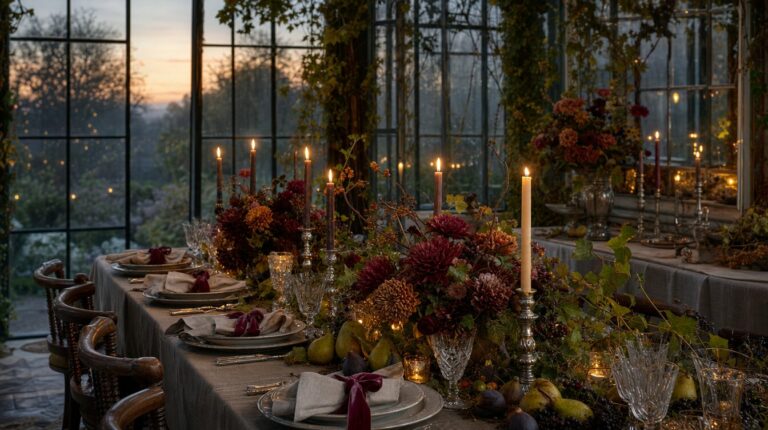
The tablescape — the art of dressing a dining table with flowers, linens, candles, objects, and the careful choreography of china and glass — has become, in recent years, something of a minor obsession. Instagram is awash with them. Wedding stylists have built entire careers on them. There are now tablescape workshops, tablescape consultants, and at least one coffee-table book devoted entirely to the subject. And yet the line between a tablescape that enchants and one that overwhelms is thinner than most hosts realise. A tablescape should invite guests to sit down. It should not make them afraid to move a fork.
The best dinner-party flowers are like the best dinner-party guests: present, beautiful, and never in the way. They should enhance the evening without demanding attention. They should create intimacy without obstructing conversation. And they should, above all, be arranged in such a way that everyone at the table can see everyone else. A centrepiece that blocks sightlines is a social catastrophe disguised as an aesthetic triumph. I have sat at tables where I spent three hours talking to a floral arrangement because I could not see the person opposite me. The arrangement was magnificent. The dinner party was a failure.
The Low Meadow
For a long rectangular table — the kind that seats ten or twelve, the kind that forces you to choose between talking to the person on your left and the person on your right — the most effective arrangement is the one you can see over. I call this the Low Meadow: a line of small bud vases, each holding two or three stems, snaking down the centre of the table in an informal, meandering line. It creates intimacy without obstruction. It allows guests to see each other and reach across for the wine. It is, in essence, a deconstructed centrepiece — the impact of a larger arrangement, broken into manageable, conversational pieces.
The vessels should not match. A ceramic beaker here, a cut-glass tumbler there, a tiny terracotta pot, a sake cup, a laboratory flask — the variety is the point. Uniformity feels like a hotel restaurant. Mismatch feels like a home. The stems should be seasonal and unforced, the kind of things you might pick on a walk: wild carrot, scabiosa, love-in-a-mist, a single garden rose in each vessel, a stem of mint or rosemary for scent. Nothing tall. Nothing that blocks the view. Nothing that looks like it was arranged by a professional — even if it was.
Between the bud vases, scatter a few votive candles in clear glass holders. Tea lights are fine; nothing scented, which competes with the food. The combined effect, when the candles are lit and the wine has been poured, is of a table that glows rather than dazzles — a table that invites leaning in, not sitting back.
The Single Statement
For a round table of six to eight — the most sociable configuration, the one where everyone can talk to everyone — a single larger arrangement in the centre can work beautifully. But the rule is absolute: it must be below eye level. If a seated guest cannot see the person opposite them over the top of the flowers, the arrangement is too tall. If a guest cannot reach the salt without navigating a thicket of foliage, the arrangement is too wide.
The ideal single-statement arrangement for a round table is wide and low: a generous, shallow bowl filled with a dense dome of hydrangea heads in a single colour, or a cluster of dahlias massed tightly together, placed on a stack of two or three old books to give it height without bulk. The books serve a double purpose: they elevate the flowers so they sit at the right level, and they introduce a different texture — paper, cloth, leather — that breaks up the visual field of china and glass and linen.
Alternatively, for a more casual dinner, dispense with the centrepiece entirely and give each guest a single stem at their place setting — a dahlia, a rose, a stem of delphinium — laid flat across the dinner plate or tucked into a folded napkin. It costs almost nothing. It takes thirty seconds per setting. And it makes every guest feel, before they have even sat down, that this evening matters.
What not to do
Some things I have learned the hard way. Do not use scented candles on a dining table — they fight the food. Do not use flowers with heavy pollen — lilies, in particular, will shed orange dust all over your tablecloth and your guests’ clothing. Do not use anything that drips sap — euphorbia and some euphorbia relatives will weep a milky substance that irritates skin. Do not use anything that smells stronger than the food — tuberose, hyacinth, and paperwhite narcissus are all magnificent in a hallway, but at the dinner table they are olfactory bullies.
Most of all, do not overthink it. The tablescape that works is almost never the one that was planned for weeks. It is the one that was put together in the hour before guests arrived, with whatever was in the garden and whatever vessels were clean. The best dinner parties are not productions. They are gatherings. Flowers at dinner should be like a good guest — present, beautiful, and never the point.