Juliette Blanc has a rule about tables. It is not about tablecloths, or china, or the correct placement of the fish knife. It is about flowers. ‘The arrangement,’ she told me, standing in the kitchen of her stone farmhouse in the Luberon valley, ‘should be something you want to eat.’ She was arranging a bowl of artichokes, figs, and vine leaves — not a flower among them — and the effect was so lush, so abundant, so edible-looking that I understood immediately what she meant. The table should make you hungry. The flowers should make you want to reach across and touch them. Formality is the enemy of appetite.
Blanc is a floral designer who works almost exclusively in Provence, where she moved from Paris fifteen years ago after a career in fashion PR. She now runs a small but legendary workshop from her farmhouse near Bonnieux, supplying flowers and designing tables for weddings, private dinners, and the occasional restaurant residency. Her approach to entertaining is so relaxed it borders on philosophical. ‘A luncheon in Provence,’ she said, ‘is not an event. It is a condition. It is what happens when it is too hot to do anything else, and someone has made a terrine, and there are figs on the tree, and you have been working in the garden all morning and you are hungry. You do not plan a Provençal lunch. You surrender to it.’
The table as landscape
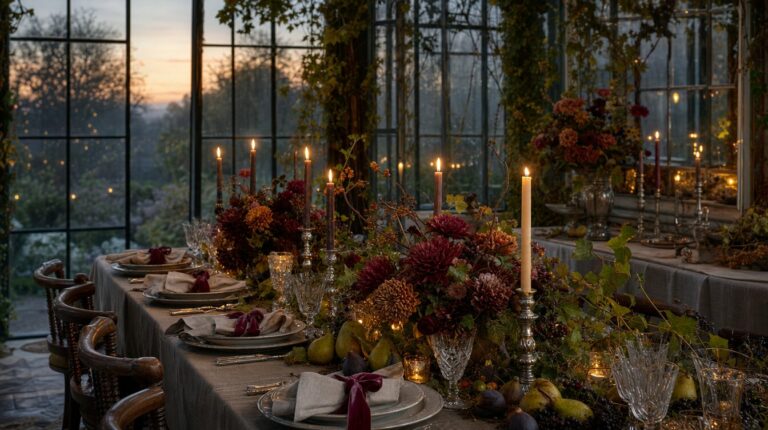
Blanc’s tablescapes are famous for not looking like tablescapes. There are no symmetrical arrangements, no matching vessels, no sense that anything has been placed rather than gathered. For a recent dinner for twelve, set under the plane trees in her courtyard, she covered the table with a length of undyed linen, scattered fig leaves and unripe grapes directly onto the cloth, and placed at intervals small clusters of whatever was growing: a bunch of lavender tied with raffia, a terracotta pot of rosemary, a single sunflower in a water glass, a bowl of apricots and almonds. The effect was of a table that had been set by the landscape itself.
‘The mistake people make,’ she said, pouring pastis into a glass the size of a small fishbowl, ‘is thinking that a table needs to be designed. It does not. It needs to be inhabited. You are not decorating a surface. You are creating a place where people will sit for three hours. The table should feel like it has been there for a hundred years, even if you set it ten minutes ago.’
Her method is deceptively simple. Start with a cloth — always linen, always unironed, because ‘ironed linen is a contradiction.’ Add something from the garden — not flowers necessarily, but something living: a pot of herbs, a branch of olive, a bowl of lemons. Let the food be the centrepiece. The flowers, if there are any, should be small, informal, and placed near the guests, not in the centre of the table. ‘A flower by your plate is intimate,’ she said. ‘A flower in the middle of the table is a centrepiece. Centrepieces are for hotels.’
The long lunch
A Provençal lunch, in Blanc’s world, follows a rhythm as old as the hills. It begins at one and ends when it ends — four, five, the sun going down behind the cypresses. There are courses, but they arrive without announcement, brought from the kitchen whenever they are ready. A terrine of rabbit and pistachio. A salad of tomatoes and torn basil from the pot by the door. A platter of roasted peppers, still warm, their skins blackened and peeled. Cheese from the village — a banon wrapped in chestnut leaves, a hard sheep’s cheese with a rind the colour of the limestone cliffs. Fruit from the trees: figs split open, their pink interiors glistening, apricots that taste of sunshine in a way that supermarket apricots have forgotten.
The flowers on the table are not arranged. They are present — a few stems in a jar, a pot of thyme, a branch of something that was pruned that morning and looked too beautiful to throw away. They do not compete with the food or the conversation. They are simply there, like the cicadas and the pastis and the particular quality of the light in Provence in July. They are the background to a lunch that is not really about lunch at all — it is about sitting still, in good company, while the afternoon drifts past.
Before I left, Blanc gave me a bunch of lavender tied with a piece of kitchen string. ‘Put it in your bedroom,’ she said. ‘Not in a vase. Just put it on the pillow. It will remind you that the best things are the simplest ones.’ I did. It did. And every time I smell lavender now, I think of that courtyard, that table, those figs, and the particular, irreproducible generosity of a long lunch in Provence.