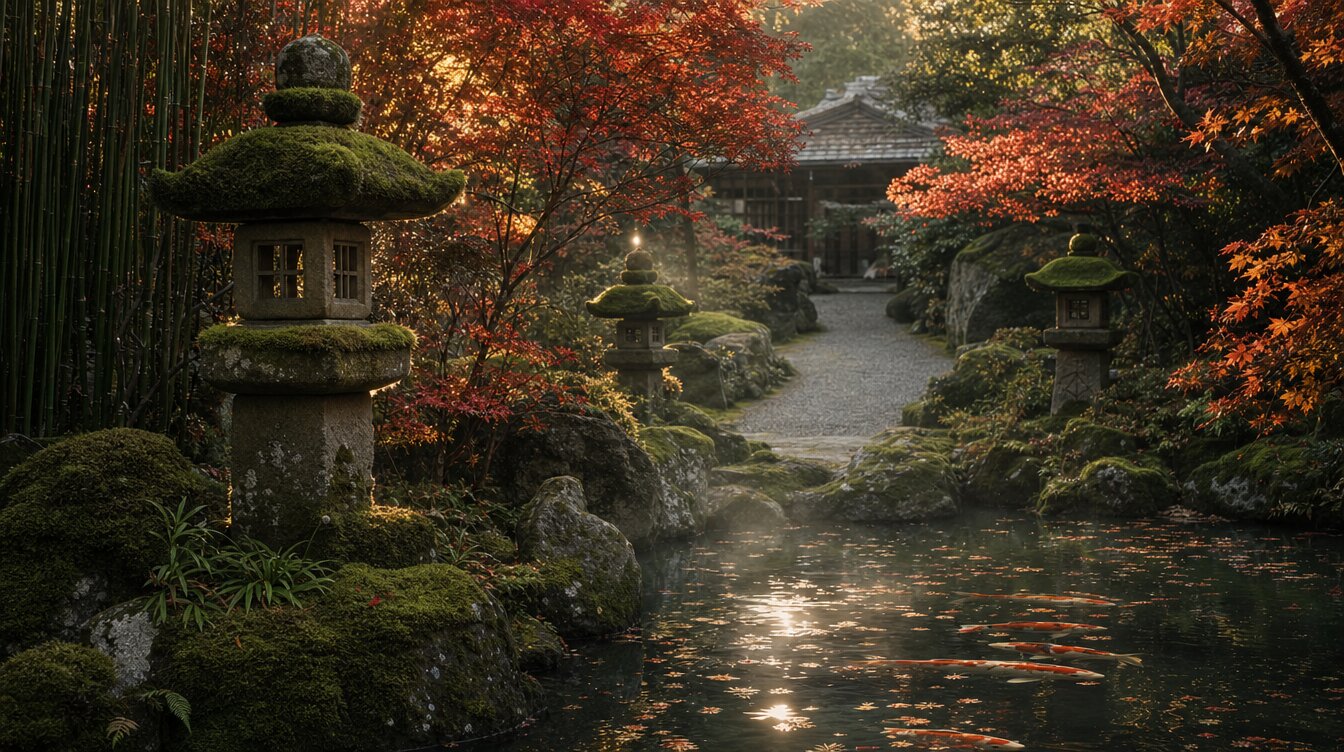
There is a particular quality of light in Kyoto that exists nowhere else. It filters through ancient cedar and bamboo, falls across raked gravel, and settles on moss with the weight of centuries. To walk through the temple gardens of Japan’s old capital is to understand that gardening, at its most profound, is not about cultivation at all — it is about time made visible.
I arrived in Kyoto in late November, when the maple trees were at the peak of their transformation. The Japanese have a word for this — momijigari, the ritual of hunting autumn leaves — and it is pursued with the same reverence the English reserve for the first asparagus of spring or the French for the arrival of the Beaujolais Nouveau. Entire families plan their holidays around the precise moment when a particular temple’s maple grove will ignite into crimson.
But I had not come for the spectacle. I had come for the gardens that lie behind the gardens — the ones that do not appear on postcards, that require a deliberate turning away from the obvious view. These are the gardens that reveal themselves slowly, that demand stillness, that would be invisible to anyone moving at the pace of a tourist itinerary.
The Garden as Philosophy
At Daitoku-ji, a vast temple complex in the north of the city, there are twenty-two subtemples. Most visitors see perhaps three. I spent a week there, returning each morning, and by the third day the monks had stopped asking for my ticket. They simply nodded, recognising something they had seen before — the particular expression of someone who has begun to understand that a Japanese garden is not something you look at, but something you enter into a conversation with.
The karesansui — the dry landscape garden — is the form most familiar to Western eyes, and the most misunderstood. At Daisen-in, the celebrated garden attributed to the monk-painter Soami, visitors crowd along the veranda taking photographs of what they have been told is a masterpiece. The gravel represents water, the rocks represent mountains, the moss represents islands. This is the explanation offered by every guidebook, and it is perfectly correct and perfectly useless.
What the guidebooks cannot convey is that the garden is a koan — a puzzle designed not to be solved but to be lived with. The rocks do not represent mountains; they are the question that mountains ask of the mind. The gravel is not water but the idea of water, which is infinitely more interesting. To sit before Daisen-in for an hour is to watch your own thoughts arrange themselves into patterns as precise and as meaningless as the raked gravel. This is the point. This is the practice.
The Gardens That Nobody Photographs
The most beautiful garden I found in Kyoto was not on any itinerary. I had spent the morning at Kinkaku-ji — the Golden Pavilion, the most photographed site in Japan — fighting through crowds of schoolchildren and selfie sticks, and I fled north along a narrow lane that followed the mountainside. After twenty minutes of walking, the city fell away. The lane became a path, and the path led to a small wooden gate, and beyond the gate was a garden that had no name.
It was a tea garden — a roji, or “dewy path” — and it was perhaps thirty feet square. A stone water basin, a single camellia bush, a stepping-stone path worn smooth by centuries of feet. Moss covered everything that was not stone, and the moss itself was a landscape — hills and valleys of emerald velvet, miniature forests of fern and lichen. A bamboo pipe dripped water into the basin with a sound so precise it might have been composed.
This is the garden reduced to its essence: a path, a stone, a sound. The Japanese have a term, yohaku no bi — the beauty of empty space. It is the aesthetic principle that governs not only gardens but calligraphy, flower arrangement, poetry. What is left out matters more than what is included. The empty gravel is not empty; it is the space in which meaning occurs.
Moss, Time, and the Art of Waiting
At Saiho-ji, the temple known as Kokedera — the Moss Temple — you must apply in advance by post. You must include a self-addressed return envelope with an international reply coupon. You must arrive at the appointed hour, remove your shoes, and spend twenty minutes copying a sutra with a brush and ink before you are permitted to enter the garden. This is not bureaucracy. This is preparation. The garden demands that you arrive in the right state of mind, and the mind, like moss, grows slowly.
The garden itself is a carpet of more than one hundred and twenty species of moss, spread beneath a canopy of maple and cedar that filters the light into something liquid and green. There is no gravel here, no dramatic rock arrangement. There is only moss, water, and the slow work of eight centuries. The garden was first laid out in 1339 by the monk Muso Soseki, who understood something that every gardener eventually learns: the best gardens are not designed. They are allowed.
“A garden is never finished,” a monk told me as I sat on the veranda at Saiho-ji, my sutra copying complete, my mind finally quiet. “It is always becoming. Like a person.” He gestured at the moss. “This garden looked nothing like this fifty years ago. Fifty years from now, it will look nothing like this. The garden you are seeing exists only now, only for you. Tomorrow’s garden will be different. Tomorrow’s visitor will see something you did not.”
Bringing It Home
I returned from Kyoto not with a list of plants to acquire or techniques to emulate, but with a question: what would it mean to garden with yohaku no bi — with reverence for empty space? In a Western garden, we fill. We fill beds, fill borders, fill pots, fill windowsills. Abundance is our aesthetic, and it is a beautiful one. But what if we left something out?
In my own garden now, there is a patch of gravel in the shade of a winter-flowering cherry. It is perhaps four feet square, and it contains one stone. I rake it sometimes, not because it needs raking but because the act of raking is itself the practice. Visitors ask what it is. “It’s a garden,” I say. They look for the plants, the flowers, the point. Some of them see it. Most of them don’t. That’s all right. The garden is not for them. It is, like all the best gardens, a conversation between the gardener and time.