The Brief: Flowers First
The instruction came in an email no longer than a shopping list. “We want the flowers to be the reason people remember this wedding. Everything else—the dress, the food, the music—should feel like it’s in service to the flowers.” It was, the bride later explained over a pot of Earl Grey in her Chelsea sitting room, the only brief that had ever made sense to her. She had spent a decade attending weddings where the flowers were an afterthought—a few pew-ends sourced reluctantly from the venue’s preferred supplier, a top-table arrangement that had clearly been recycled from the morning’s corporate event. She wanted the opposite. She wanted a wedding that felt like walking into a Dutch still life.
This is not the brief most florists receive. The typical wedding enquiry begins with the dress, or the venue, or the date, and the flowers are asked to follow obediently behind, matching a swatch, filling a gap, staying within a line item. But a small and growing number of couples—and, crucially, the florists they choose to work with—are reversing the hierarchy. When the flowers become the organising principle of a wedding, something shifts. The day acquires a coherence that no amount of coordinating table linens can achieve. The flowers stop being decoration and become architecture.
The Village Church That Became a Painting
St Mary’s in Litton is not a grand church. It is a twelfth-century stone box in a Somerset village of perhaps two hundred people, with a squat tower, uneven flagstones, and a smell of damp wool and brass polish that no amount of wedding prep can entirely dispel. It has no electricity to speak of, no heating, and a single narrow aisle that forces brides to walk sideways if their dress has any volume at all. It is, in other words, an objectively difficult space for a wedding. And it is precisely where Florence Hartley, the florist behind the Cotswolds-based studio Hartley & Thorne, produced what might be the most astonishing wedding flower installation in recent memory.
The couple—a gallerist and a landscape architect—had found St Mary’s on a rain-soaked reconnaissance trip in February. The church was locked, the graveyard was mud, and the interior, when they finally persuaded the churchwarden to let them in, was essentially a stone refrigerator. But the gallerist saw a seventeenth-century Dutch church interior painting; the landscape architect saw a framework for a garden that happened to have a roof. Hartley saw both. Her proposal was deceptively simple: treat the entire nave as a single arrangement. No distinction between pew-end and archway and altar. One continuous botanical gesture from the lychgate to the chancel steps.
The installation took four days and three van-loads of material. Hartley and a team of five arrived on the Wednesday for a Saturday wedding—a lead time that even she admits was “borderline reckless” given the ambition. They built a substructure of chicken wire and moss-wrapped armatures that ran the length of the aisle, fastened to the flagstones with weights rather than fixtures (the churchwarden had been specific about the listed-building restrictions). Into this they wove foxgloves and delphiniums grown specifically for the wedding by a flower farmer in Bruton, peonies from a walled garden in Dorset, and garden roses in four shades of burgundy sourced from a specialist grower in Herefordshire. The foliage was almost entirely foraged: cow parsley from the verges along the B3135, beech branches from the churchyard itself, ferns from a nearby wood whose landowner had been persuaded over a pint of Butcombe at the village pub.
By Saturday morning, St Mary’s had ceased to be a church. It was a garden that happened to contain pews. The congregation entered through a tunnel of greenery. The aisle was a river of petals and loose stems that brushed against ankles as guests took their seats. The altar—bare stone the week before—was invisible behind a cascade of roses that seemed to grow from the masonry itself. “People cried before the bride arrived,” Hartley recalled, with the matter-of-factness of someone who has seen this reaction before and is still genuinely moved by it. “Not polite tears. Proper, shoulder-shaking crying. Because the space itself was saying something that the service hadn’t started to say yet.”

The Economics of Making Flowers the Lead
Let us speak plainly about money, because any discussion of wedding flowers that avoids the subject is a fantasy. A wedding where the flowers are the main event will cost more than a wedding where they are not. The question is not whether the budget is larger—it will be—but whether the reallocation of funds produces a wedding that feels genuinely different, rather than merely more expensive. The answer, in the experience of the florists interviewed for this piece, is a qualified yes. A qualified yes that requires couples to be honest about what they are willing to sacrifice.
Hartley & Thorne’s Somerset installation cost approximately £28,000. For context, the average UK wedding flower budget in 2025 was £1,500, according to the industry survey conducted by Bridebook. The Somerset wedding was, at nearly twenty times the average, an outlier. But the figure is less shocking when you understand what it replaced. The couple spent £400 on the dress (a vintage 1940s bias-cut gown from a dealer in Hastings). The catering was a fish-and-chip van parked in a field next to the reception barn. The band was the groom’s university jazz quartet, paid in beer and a generous contribution to their travel costs. The photography was a friend’s wedding gift. Every saved pound went into the flowers.
“People think ‘flowers first’ means spending an extra ten thousand pounds on top of an already expensive wedding,” said Catherine Legrand, a London-based wedding florist whose clients range from Notting Hill lawyers to Somerset farmers. “It doesn’t. It means deciding, at the very beginning, that the flowers are the priority and then building the rest of the wedding around that decision. It means the dress budget might be smaller. It means the venue might be simpler—in fact, it should be simpler, because a plain space shows off flowers better than a busy one. It means the food might be less elaborate. These are not sacrifices anyone notices, because nobody leaves a wedding saying, ‘The canapés were nice, but the flowers were too beautiful.'”
The more practical financial insight is this: splurging on flowers while skimping on everything else is a philosophy that works best in specific kinds of venues. A marquee in a field, a village hall, a barn with good bones, a church like St Mary’s that provides its own ancient atmosphere. These spaces are blank canvases, and blank canvases reward investment in the thing you put in them. A grand hotel ballroom with chandeliers and gold leaf, by contrast, will fight your flowers for attention and probably win. If you want the flowers to be the main event, choose a venue that knows how to step back.
The Florist as Creative Director
When the brief is “flowers first,” the florist’s role changes. They cease to be a supplier and become, in effect, the creative director of the wedding. This is a relationship that requires trust, communication, and—crucially—the right florist. Not every florist wants this responsibility, and not every florist who wants it can handle it.
The right florist for a flowers-first wedding possesses three qualities that are not always correlated with technical skill. The first is spatial intelligence: the ability to walk into an empty room, or a church, or a field, and see not what is there but what could be there. This is not the same as the ability to arrange flowers beautifully in a vase. It is closer to set design, or landscape architecture, or installation art. It requires thinking about sightlines (can the guests in the back pew see anything?), about progression (does the floral narrative build toward the altar?), about negative space (where does the eye rest?), and about the physical experience of walking through a botanical environment.
The second quality is logistical nerve. The Somerset installation required Hartley to coordinate three separate growers, a refrigerated van hired from Bristol, a team of five who needed accommodation in a village with one pub and no B&B, and a churchwarden who initially refused to allow anything to touch the stonework. At no point did she appear flustered, at least not in front of the couple. “The bride should never know about the dahlia that didn’t open or the eucalyptus that arrived brown,” she said. “She should only know that she walked into a garden.”
The third quality is harder to define but easy to recognise when you see it: a kind of aesthetic conviction that borders on obsession. The best florists have strong opinions. They will tell you that pale pink and peach is a combination that died in 2014 and should stay dead. They will refuse to work with certain varieties because those varieties don’t hold up in August heat. They will gently override a bride’s Pinterest board with a vision that is more coherent, more original, and sometimes more challenging. The florist who says “yes” to everything is not the florist you want for a flowers-first wedding. You want the florist who says, “I have a better idea.”
The Ceremony: Building a Botanical Cathedral
The ceremony is where the flowers-first approach makes its most dramatic argument. A well-dressed altar is a lovely thing. A ceremony space that has been fundamentally transformed by flowers is a different category of experience entirely. It changes the energy of the room before anyone has spoken a word.
The key structural decisions for a ceremony installation are: the entrance (what guests walk through), the aisle (what they walk alongside), and the focal point (what they look at during the vows). Each element should feel distinct but related—different movements in the same piece of music. At the Somerset wedding, the lychgate was wrapped in beech and cow parsley, the aisle was a loose meadow of stems at floor level, and the chancel was a vertical explosion of delphiniums and roses that drew the eye upward. The progression was from wild to cultivated, from green to colour, from horizontal to vertical. It was not random. It was choreographed.
Entrances matter disproportionately. The moment of crossing the threshold is the first sensory impression of the wedding, and in a flowers-first ceremony it should be overwhelming. Hartley recommends thinking of the entrance as a compression that releases. “You want people to walk through something dense—a tunnel, an arch, a curtain of greenery—and then emerge into the space. The contrast is what makes the space feel vast, even if it’s objectively small.” At St Mary’s, the tunnel was six feet of woven branches that made the west door feel like a portal. Guests bent their heads slightly to pass through, a physical gesture of entering somewhere sacred.
The aisle itself is the most difficult element to get right, because it has to work at two scales simultaneously. From the back of the church, it must read as a coherent sweep of colour and texture. But up close, for the guests sitting in the pews, it must reward intimate inspection. This is where the skill of the florist is most exposed. Loose mechanics—visible wire, soggy moss, a gap where a stem should be—are invisible from twenty feet but glaring from two. Hartley’s approach is to build the aisle installation in layers, with the largest structural elements placed first and the finest detailing done last, from the perspective of someone sitting in the front pew.
The focal point—usually the altar, a chuppah, or a ceremonial arch—should be the most concentrated expression of the floral brief. At St Mary’s, the altar arrangement was so dense that the stone was invisible. It was also asymmetrical, which is counter-intuitive for a wedding but produces a more natural, less “event floristry” effect. “Symmetry is for hotel lobbies,” Hartley said, with the conviction of someone who has spent years unlearning the habits of traditional floristry training. “Nature is asymmetrical. A garden is asymmetrical. The most beautiful things are off-balance in a way that feels intentional.”
The Reception: Tables, Light, and the Art of Not Overdoing It
If the ceremony is where the florist makes the grand statement, the reception is where the skill lies in restraint. A room full of tables, each one crowned with a foot-high arrangement, is the floral equivalent of shouting. Nobody can hear anyone else. The flowers compete with the food, the conversation, and each other. The result is visual noise.
The flowers-first approach to the reception is, counter-intuitively, to do less. Lower arrangements that sit below the sightline—what florists call “conversational height”—allow guests to see each other across the table while still being surrounded by flowers. A long trestle table with a meandering runner of greenery, punctuated by clusters of small vessels at varying heights, creates more impact than a formal centrepiece because it draws the eye along the length of the table rather than anchoring it in one spot.
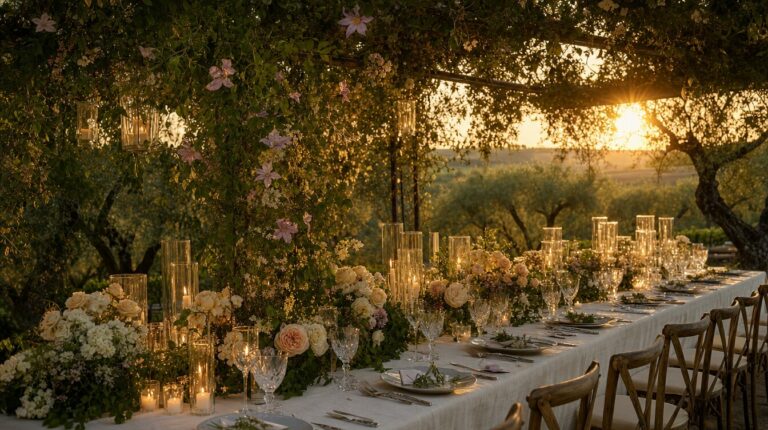
At the Somerset reception, held in a converted stone barn a mile from the church, the tables were dressed with a combination of bud vases, each containing a single garden rose or dahlia, and low bowls of seasonal fruit—figs, blackberries, and small pears—interwoven with ivy and trailing rosemary. The effect was less “wedding reception” and more “eighteenth-century still life that has come to life and invited guests to sit down.” Candles in amber glass holders provided the only additional light beyond the barn’s existing lanterns. No fairy lights, no overhead washes of pink, no LED uplighting on the walls. “Lighting is the thing that ruins most wedding receptions,” Legrand observed. “You spend thirty thousand pounds on flowers and then the DJ points a magenta spotlight at them. Suddenly your hand-tied garden roses look like they belong in a nightclub in Luton.”
Of all the reception flower decisions, the head table is the one most likely to go wrong. The impulse—encouraged by decades of wedding magazines and Pinterest—is to make it the biggest, most elaborate arrangement in the room. But the head table already has attention because the couple is sitting at it. It does not need to shout. A simpler treatment—a single long garland of the same greenery used throughout the ceremony, with small clusters of flowers at intervals—creates a visual link back to the church without overwhelming the people sitting there. “The head table,” Legrand said, “should frame the couple, not compete with them.”
The Flowers That Stay With You
There is a particular kind of post-wedding sadness familiar to anyone who has planned an elaborate event. It is not the comedown of the day being over—that passes. It is the knowledge that the thing you spent months creating, the installation that took four days and three van-loads and a team of six, no longer exists. The flowers that made people cry at St Mary’s were composted within a week. The aisle meadow was swept up on Sunday morning by the churchwarden, who was kind enough to wait until the couple had left for their honeymoon. The tunnel was dismantled and the branches returned to the wood they came from.
This is not a tragedy. It is, in fact, part of the point. The impermanence of flowers is what gives them their emotional weight. A marble altar is permanent and impersonal. A cascade of garden roses that will wilt by Tuesday is a declaration: this moment matters enough to warrant something that cannot last. The couples who plan flowers-first weddings tend to understand this intuitively. They are not trying to build a monument. They are trying to create an experience that feels unrepeatable, because it is.
What remains, of course, is the photographs. In the Somerset wedding album, the flowers are not background. They are characters. The aisle meadow appears in every shot of the processional, a river of colour that makes the bride’s simple dress look like the most deliberate choice of the entire day. The altar arrangement frames the vows. The bud vases on the reception tables catch the candlelight in ways no lighting designer could have predicted. These photographs will outlast the flowers by decades, and in them the flowers look exactly as they did: like the main event.
Perhaps the truest measure of a flowers-first wedding is what guests remember six months later. “People don’t remember the food,” Hartley said. “They remember whether they felt something. Flowers make people feel something. I’ve had guests write to me months after a wedding to say they’ve started growing sweet peas because of what they saw in a church in Somerset. That’s not decoration. That’s influence.”
This article is the second in a series exploring the art and craft of wedding floristry. Next month: the sustainable wedding—how to throw a celebration where every stem has a second life.