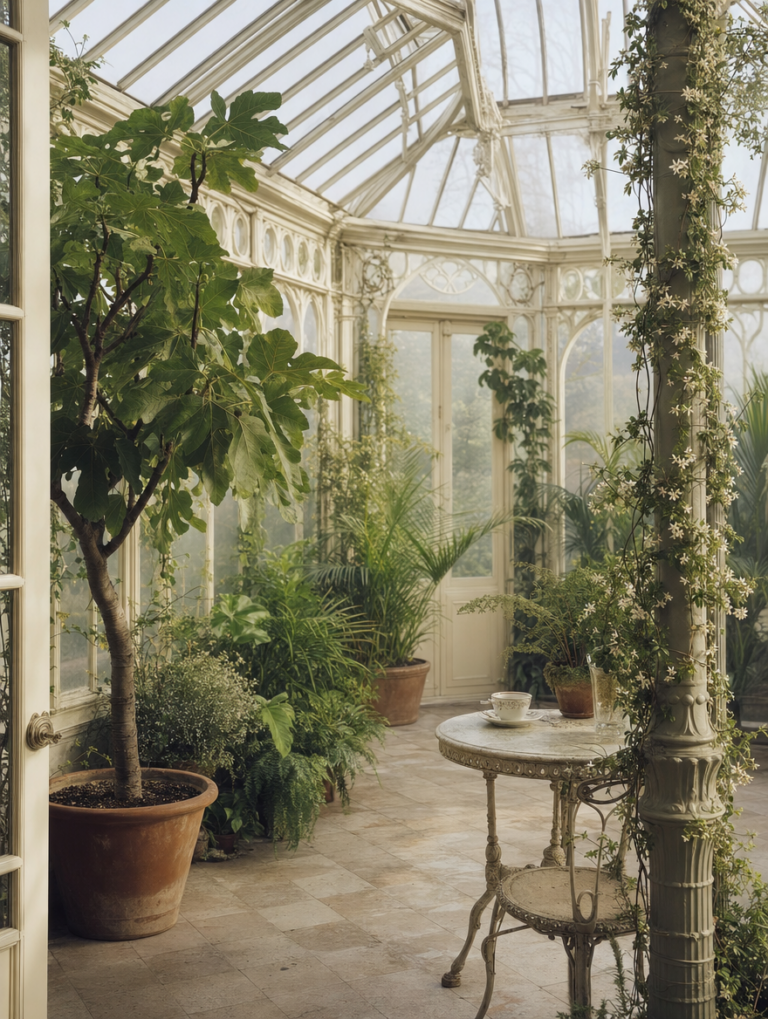
There is a particular kind of quiet that descends on a balcony at six in the morning, when the city is still half-asleep and the only sound is water trickling from a watering can onto terracotta. I have known this quiet for seven years now, on a balcony that measures precisely two metres by two and a half — five square metres of stamped concrete suspended four storeys above a south London street. From this modest rectangle, I have cut sweet peas in June, dahlias in September, and on one improbable November morning, a single perfect ‘Souvenir de la Malmaison’ rose that had refused to acknowledge the season. This is not a story about deprivation or making do. It is about the radical proposition that you do not need a country garden, a cutting patch, or even a patch of earth to grow flowers worth putting in a vase. What you need is five square metres, a willingness to think vertically, and the conviction that the smallest garden is still a garden.
This manifesto is for the apartment dweller who scrolls through Sarah Raven’s catalogue and thinks, maybe one day, when I have a garden. It is for the renter who believes — wrongly — that a temporary home means you cannot commit to plants. It is for anyone who has ever stood on a balcony, looked at the bare concrete, and wondered whether beauty could take root there. It can. It does. Here is how.
The Five-Square-Metre Revolution
Let us begin by dispatching the most persistent myth in gardening: that scale determines significance. The great Japanese gardens of Kyoto — Ryoan-ji, Saiho-ji, the moss garden at Gio-ji — are exercises in compression, landscapes that contain mountains and rivers within dimensions smaller than a London studio flat. The tsubo niwa, or courtyard garden, a tradition dating to the Heian period, transforms slivers of space between buildings into worlds. If a Kyoto gardener can evoke the peak of Mount Horai in two square metres of raked gravel, you can grow a cutting garden on a balcony.
The balcony cutting garden is not a poor imitation of its country cousin. It is a distinct form with its own advantages. There are no slugs (at least, none that can climb four storeys). There is no bindweed. The soil — because you choose it — is free of the horsetail that has colonised every allotment in Britain since the Cretaceous. The microclimate is warmer than ground level, extending your season by two weeks at each end. And there is the inescapable intimacy of a small space: you notice every unfurling leaf because there are not ten thousand of them competing for your attention. On a balcony, you are not a manager of a landscape. You are in a relationship with individual plants.
The numbers are encouraging. Five square metres, planted intensively in containers, can support roughly twelve to fifteen productive plants at any one time — fewer if you favour dramatic specimens like dahlias, more if you lean toward slender verticals like sweet peas and climbing roses. With succession planting, a balcony can yield cut flowers from March through October. That is eight months of flowers, from a space smaller than a parking bay.
Choosing Your Cast: The Varieties That Earn Their Place
In a balcony cutting garden, there is no room for passengers. Every plant must justify its footprint. This is the essential discipline of small-space gardening: you are a casting director, and your stage is unforgiving. The brilliant debut novel may be a doorstop, but on a balcony you are editing a short story. Here are the performers who have earned their place in my production, season after season.
Sweet peas (Lathyrus odoratus) are non-negotiable. No flower rewards regular cutting with such profligate generosity. The more you pick, the more they produce — a biological bargain that feels almost unfair. Grow them in a pot at least thirty centimetres deep (their roots are deeper than you expect), train them up a bamboo obelisk or a length of jute netting fixed to the railing, and feed them weekly with a high-potash liquid fertiliser. The scent, which filled my balcony and drifted through the open window into the kitchen, is the olfactory definition of early summer. For containers, choose the shorter varieties: ‘Cupani’, the original wild sweet pea discovered by a Sicilian monk in the seventeenth century, grows to about 1.2 metres and has a fragrance that modern hybrids only gesture toward. ‘Matucana’, its close relative, is similarly compact and impossibly scented.
Dahlias are the divas of the balcony garden, and like all divas, they demand attention. But what they give back — blooms the size of dessert plates from August until the first frost — justifies every demand. The key to balcony dahlias is variety selection. Avoid the dinner-plate types that require staking against gales; choose the shorter, sturdier Bishop series (‘Bishop of Llandaff’, with its crimson flowers and chocolate-bronze foliage) or the ball and pompon dahlias (‘Jowey Winnie’, ‘Cornel’) that stay compact and produce armfuls of perfectly spherical blooms. Plant one tuber per thirty-centimetre pot in late April, stake immediately (do not wait until it needs it), and pinch out the growing tip when the plant reaches thirty centimetres to encourage the branching that produces more flowers. The first dahlia of the season, cut on an August morning while the petals are still cool, is one of the great rewards of the balcony year.
Cosmos (Cosmos bipinnatus) is the balconist’s secret weapon. It germinates in days, grows with the enthusiasm of a weed, and produces flowers — feathery, trembling, in shades from pure white through every pink to deep claret — from July until November, long after the dahlias have been blackened by frost. The trick with cosmos, counterintuitively, is poor soil. Rich compost produces foliage at the expense of flowers; a mix of multipurpose compost cut with thirty percent horticultural grit keeps them blooming. Pinch out the tips when young, stake loosely with twiggy hazel branches that the stems can grow through, and deadhead ruthlessly. ‘Purity’, the classic white, is essential; ‘Rubenza’, which opens deep ruby and ages to antique rose, is the one visitors always ask about.
Bulbs in pots — tulips, narcissus, alliums — are the advance guard of the cutting year. In November, after the dahlias have been lifted and the cosmos pulled, plant tulip bulbs in pots at three times their depth, layer them (the lasagne method: early tulips at the bottom, mid-season in the middle, late on top, all in the same deep pot), and set them against the wall where they will receive the winter chill they need to flower. By April, when the first ‘Purissima’ tulips open cream against the still-bare railing, the season has begun again.
Beyond these anchors, the balcony cutting garden can accommodate: zinnias (‘Queen Red Lime’, ‘Benary’s Giant Salmon’), which thrive in heat and produce stems that last two weeks in a vase; scabious (‘Black Knight’, ‘Fata Morgana’), whose pincushion flowers add the kind of texture that florists charge extra for; amaranthus (‘Love-Lies-Bleeding’, ‘Hot Biscuits’), for the dramatic trailing element that transforms a straightforward bouquet into something editorial; and fragrant-leaved pelargoniums, not for cutting but for the scent they release when you brush past them reaching for the watering can — a small sensory luxury that no ground-level garden provides quite so intimately.
The Vertical Dimension: Systems That Work
A balcony has walls, a railing, and possibly an overhang from the balcony above. These are not constraints. They are opportunities. The balcony cutting garden thinks upward before it thinks outward, because square metres on the floor are finite while vertical space extends generously in three directions.
The railing is your trellis. Anything that climbs — sweet peas, morning glory (for pleasure, not cutting), the climbing rose ‘Gertrude Jekyll’ if you can accommodate a deep pot — can be trained along the railing with jute twine. The railing also supports hanging pots and, critically, the S-hooks that hold buckets of cut stems while you work. I keep four S-hooks on my railing at all times; they have held everything from a bunch of dill going to seed to a small bird feeder that attracts the local sparrows, who repay the hospitality by eating aphids.
Shelving is the structural spine. A three-tier metal shelving unit, the kind sold for greenhouses, transforms the floor of a balcony into three floors. The top shelf receives the most light and is reserved for sun-worshippers (zinnias, cosmos seedlings); the middle shelf holds plants that appreciate brightness without scorching (scabious, salvias); the bottom shelf, shaded and cooler, is the nursery — seed trays, recently potted cuttings, anything recovering from transplant shock. Shelving also lifts plants above the shadow of the railing, which on many balconies steals the bottom thirty centimetres of light.
Wall-mounted planters — the pocket systems made of recycled plastic or felt — have been fashionable for a decade, and for good reason. They turn a blank wall into a living tapestry. For cutting, however, they are best used for trailing foliage (ivy, which you won’t cut but which provides the green architecture against which flowers read as brighter) and for herbs (mint, lemon verbena, rosemary) that perfume the air and occasionally supplement an arrangement. I keep a pocket of mint — not for the kitchen, which is six steps away, but for the scent that rises when I water it at dusk. These are the dividends a balcony pays that a garden cannot match: the proximity of fragrance, the immediacy of a leaf brushing your arm as you reach across.
Soil, Water, Light: Mastering the Balcony Microclimate
A balcony is not a garden bed raised four storeys. It is a distinct climate with its own physics. Understanding this physics is the difference between a balcony that flourishes and one that frustrates.
Wind is the invisible enemy. At ground level, wind is moderated by hedges, walls, neighbouring buildings, and the friction of the earth’s surface. Four storeys up, wind accelerates as it funnels between buildings. It desiccates leaves, snaps stems, and tips over unweighted pots. The balconist’s first purchase should not be seeds but ballast: heavy terracotta pots (not plastic, which blow over in anything above a stiff breeze), weighted with a layer of gravel at the base. A windbreak — reed screening attached to the railing, or a strategic arrangement of taller plants on the windward side — reduces desiccation measurably. I learned this the hard way in my first season, when a March gale deposited my entire cosmos crop, pots and all, in a heap in the corner. The cosmos recovered. My confidence took longer.
Watering is the daily office. Containers dry out faster than ground soil — that much is obvious. Less obvious is that they dry out at different rates depending on material (terracotta breathes and loses moisture through its walls; glazed ceramic does not), colour (dark pots absorb heat and evaporate faster), and position (pots on the railing edge, exposed to wind, need twice the water of pots against the wall). The balcony gardener develops a sixth sense for the weight of a pot — a dry pot feels disturbingly light, a watered pot has heft — and learns to check by touch rather than by schedule. In high summer, a five-square-metre balcony may need watering twice daily. This is not a chore. It is the ritual that connects you to your plants, the five minutes in the morning and the ten minutes in the evening when you look at every leaf, notice every new bud, and catch problems — aphids, mildew, the first yellowing leaf — before they become crises.
Light is your most precious resource, and you must be honest about it. A north-facing balcony will not grow dahlias; a south-facing balcony in July will scorch sweet peas by noon. Assess your light with the precision of a surveyor: how many hours of direct sun does each section of the balcony receive, and at what time of day? Morning sun is gentler and more valuable than afternoon sun. A balcony that receives four hours of morning light will outperform one that receives six hours of harsh afternoon exposure. Map your light, then place your plants accordingly. The south-facing edge of the railing is for the Mediterranean plants — lavender, rosemary, the scented pelargoniums that evolved on South African cliffs. The shaded corner against the wall, which receives only an hour of dappled light, is for the ferns (not for cutting, but for the cool green presence they provide) and for pots of mint and lemon balm, which will grow almost anywhere.
The Cut-and-Come-Again Principle: Harvesting as Gardening
The balcony cutting garden fundamentally reorients the relationship between gardener and plant. In an ornamental garden, you live alongside your flowers; in a cutting garden, you harvest them. This is not a loss but a transaction — and the most productive cutting plants are those that respond to harvesting by producing more. This is the cut-and-come-again principle, and it is the engine of the small cutting garden.
Sweet peas are the purest example. Left uncut, a sweet pea plant will set seed and stop flowering within three weeks. Cut every stem as soon as the lowest flower opens, and the same plant will produce flowers for two months. The mechanism is botanical logic: a plant whose reproductive cycle is interrupted will keep trying. Your vase is an instrument of perpetual bloom.
Cosmos, zinnias, and dahlias follow the same principle, though each has its quirks. Cosmos should be cut when the petals are just unfurling; if left too long, the stems become woody and the vase life shortens. Zinnias benefit from the “wiggle test” — grasp the stem about twenty centimetres below the flower and wiggle; if the stem bends, it is not yet ready; if it stays rigid, cut. Dahlias should be cut in the cool of early morning, when the stems are full of water, and immediately plunged into a bucket of tepid water that you have carried onto the balcony for this purpose. This is the rhythm of the cutting garden: cut, condition, arrange, and by the time the vase on the kitchen table needs refreshing, the plants have produced more.
The conditioning bucket — I use a simple galvanised steel pail — is the most underrated tool in the cut-flower arsenal. Cut stems should rest in water for at least two hours, preferably overnight, in a cool dark place before arranging. This is when they take up water and harden off, extending vase life by days. On a balcony, the bucket lives under the bottom shelf during the day and comes inside at night. It is a humble object, but it is the bridge between the garden and the house, the staging post where harvested stems become an arrangement.
A Year on a Balcony: The Seasonal Calendar
The balcony cutting garden has its own calendar, distinct from the ground-level garden’s. It starts earlier (the warmth of the building radiates through the walls and floor), peaks in the same months, and extends later (pots can be moved against the building for frost protection). Here is the year as I have lived it.
January–February: The planning months, when the balcony is dormant but the mind is not. This is when seed catalogues are annotated, when the previous year’s successes and failures are reviewed in a notebook, and when the sweet pea seeds are sown indoors on a windowsill in root trainers. (Root trainers — those deep, hinged plastic cells — are essential for sweet peas, whose roots resent disturbance. They are the one piece of equipment I would rescue from a fire.) The balcony itself holds only the structural plants: a pot of evergreen jasmine for winter scent, the rosemary that has survived three winters, and the tulip pots, whose bulbs are stirring invisibly underground.
March–April: The season begins. Tulips open — ‘Purissima’ first, then ‘Ballerina’ with her tangerine scent, then the dark, dramatic ‘Queen of Night’. Hardy annuals (larkspur, cornflowers, annual scabious) are sown directly into pots, and the greenhouse shelving unit fills with seed trays. By late April, the sweet pea seedlings are hardened off and moved to their permanent pots on the railing, where they will spend the next five months.
May–June: The sweet peas begin, and for six weeks they are the main event. I cut them every other day, arms full of stems that fill the flat with the scent of a Victorian conservatory. The cosmos seedlings are planted into their final pots, the dahlia tubers are waking up, and the first hardy annuals — cornflowers in deep blue, the almost-black scabious ‘Ace of Spades’ — join the sweet peas in the bucket. This is the month when the balcony tips from project to paradise.
July–August: High summer. The balcony is at maximum capacity — every pot occupied, every shelf full, the railing a curtain of green. The cosmos hits its stride; the zinnias open in colours so intense they seem electrically lit. And the dahlias — finally, the dahlias — begin, each bloom a small miracle of geometry that you grew yourself. Watering is twice daily. Deadheading is constant. The bucket is never empty. This is the balcony’s best self, and every morning, stepping out with the watering can, I feel something close to pride. Pride, in a rented flat with five square metres of concrete and twelve pots of flowers. The scale is irrelevant; the feeling is real.
September–October: The slow decline, which is not a sadness but a different kind of beauty. The cosmos, which has been flowering since July, is still producing — fewer blooms, but larger, as if the plant is concentrating its energy into a final gesture. The dahlias are at their peak, the September light turning their colours richer. This is the month to dry seedheads and grasses, to cut the last of the amaranthus before the frost, and to begin thinking about tulip orders. The balcony is winding down, but it is not over.
November–December: The dormant season, but not the empty season. The tulip bulbs go into their pots (this is the one major task, and it is a pleasure — the promise of spring buried in soil, like a letter to your future self). The structural plants remain: the rosemary, the jasmine, the pot of hellebores that will flower in February when nothing else is stirring. And the balcony waits. Not empty — just resting.
The Particular Joy: Arranging Flowers You Grew Yourself
I want to be precise about the quality of this joy, because it is easily sentimentalised and just as easily dismissed. It is not the joy of saving money (you will not save money; gardening, even at the smallest scale, is a luxury pursuit dressed in work clothes). It is not the joy of environmental virtue (though there is virtue in flowers that have not been air-freighted from Kenya or grown under Dutch glass). It is the joy of participation — of being inside the process rather than at its receiving end.
When you arrange flowers you have bought from a florist or a market, you are an editor. When you arrange flowers you have grown, you are an author. The difference is not semantic. The stems on your kitchen table — the sweet peas that you trained up the bamboo, the dahlias you pinched out in June, the cosmos you sowed as seeds no larger than a full stop — carry the history of your attention. They are not objects you acquired; they are relationships you maintained. The vase is an autobiography in petals.
This is why the balcony cutting garden, despite its absurd constraints — five square metres, no soil, the constant threat of wind — is not a compromise. It is the most direct form of gardening available to a city dweller. There is no land to manage, no hedges to trim, no lawn to mow. There are only the plants and you, in a space where every leaf matters because there are so few of them. The balcony imposes focus. It will not let you be vague. It demands that you choose, and in choosing, that you know — really know — what you are growing and why.
I am writing this in November, on a morning when the balcony held nothing but the rosemary, the jasmine, and four pots of tulip bulbs whose contents I will not see for four months. The shelves are bare, the S-hooks empty, the bucket stored under the kitchen sink. And yet the season does not feel absent. The tulips are underground, and underground is still gardening. The seed catalogues are on the table, and planning is still gardening. The notebook where I record which cosmos variety produced the longest stems and which dahlia succumbed to mildew — that is gardening too, the invisible half of it, the part that happens in the mind while the balcony rests.
If you have a balcony — any balcony, no matter how small, no matter which direction it faces — you have a garden. Not a pretend garden. Not a temporary garden. A real garden, capable of producing enough flowers to fill your house from March to October, capable of giving you the particular satisfaction of looking at a vase on your table and knowing that every stem in it began as a seed you pressed into compost with your own thumb. Start with one pot. One packet of sweet pea seeds. One morning in March when you push three seeds into a root trainer on a windowsill. The manifestos write themselves after that.