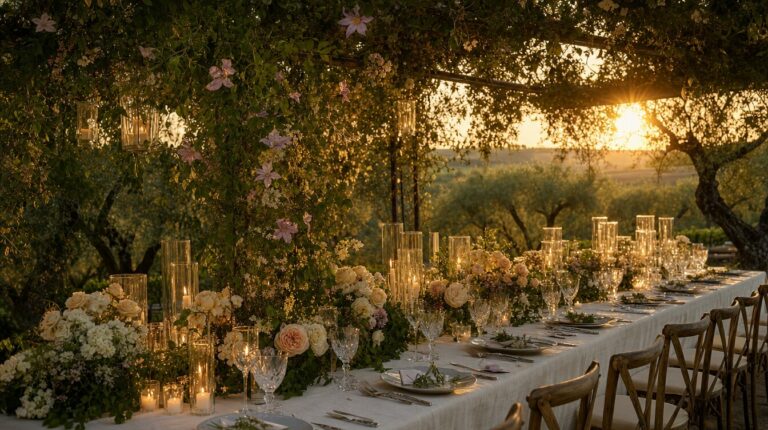
The ceremony took place in an olive grove that had been planted in 1782, on a hillside in the Val d’Orcia where the trees were so old their trunks had twisted into shapes that looked more like sculpture than botany. There was no altar — just a natural clearing between four of the oldest trees, their silver-green leaves catching the late afternoon light. There were no chairs — guests stood among the trees, or sat on bales of hay covered in linen. And there were no flowers in the conventional sense. Or rather, there were flowers everywhere, but they were not arranged. They were growing.
The bride, a landscape architect from Melbourne named Isabel, had spent the year before her wedding planting the grove. Between the olive trees, she had sown a meadow of wildflowers — cornflowers, poppies, ox-eye daisies, scabiosa, and a dozen varieties of grasses — timed so that they would be at their peak in late June. She had not designed a floral scheme. She had designed an ecosystem. ‘I did not want flowers at my wedding,’ she told me, three months later, sitting in the garden of the house in Tuscany that she and her husband, an Italian winemaker named Lorenzo, now call home. ‘I wanted to be inside the flowers. I wanted the wedding to feel like it had grown there, not been put there.’
The ceremony
The guests arrived at five o’clock, when the Tuscan sun had softened from its midday brutality into something golden and forgiving. They walked up a path lined with terracotta pots of rosemary and lavender — ‘the scents of Tuscany,’ Isabel called them, ‘and they cost almost nothing’ — and into the clearing, where a string quartet from Siena was playing something slow and Italian and unbearably beautiful. The meadow came up to their knees. Children ran through it, collecting grasshoppers. Adults stood in small groups, holding glasses of prosecco from a vineyard two hills over, looking not at an arrangement or an installation but at a field of flowers, alive and moving in the breeze, and at the two people who had decided, a year earlier, that the most romantic thing they could do was plant a field and wait.
The vows were exchanged under the oldest olive tree, its trunk so wide that three people could not have linked hands around it. There was no arch, no chuppah, no floral installation. There was just the tree, which had been standing on that hillside for two hundred and thirty-four years and which, Isabel said, ‘had seen more weddings than any of us — even if it was not invited to them.’ The rings were brought up the aisle by Lorenzo’s niece, who carried them in a nest of moss and ivy on a small wooden tray. The moss, she later informed anyone who would listen, had been collected that morning from the base of the tree.
The dinner
After the ceremony, guests walked further up the hill to a long table set under a pergola that Lorenzo and his father had built from chestnut poles and covered in the previous year’s vine prunings. The table was set for eighty, and it was, in its way, as radical as the ceremony. There were no floral centrepieces. Instead, down the centre of the table ran a river of herbs: pots of rosemary, thyme, sage, and oregano, alternating with candles in glass jars and bowls of olives from the grove below. Each guest’s place was marked with a sprig of myrtle and a hand-written card. ‘Myrtle,’ Isabel explained, ‘is the ancient Roman symbol of love. And it grows wild all over this hillside. I just walked out with a basket and picked it.’
The food was Tuscan and uncompromisingly local: antipasti of cured meats and pecorino from the farm across the valley, handmade pasta with a sauce of wild mushrooms foraged from the woods above the grove, a whole porchetta stuffed with fennel and rosemary, roasted slowly over a wood fire. The wedding cake was not a cake but a tower of local cheeses, decorated with figs and grapes and more myrtle. The wine was Lorenzo’s own — a Sangiovese from the vineyard below the olive grove, the vines planted by his grandfather in the 1950s.
At some point after midnight, when the dancing had moved from the pergola to the olive grove itself and someone had strung fairy lights between the trees, I found Isabel standing alone at the edge of the meadow, looking back at the party. ‘I spent a year planting this field,’ she said. ‘I worried about the timing, about the weather, about whether the poppies would flower at the right moment. And now it does not matter. The flowers are here, the people are here, and in a week the flowers will be gone and the field will be just a field again. But we will remember it.’ She turned to look at me. ‘That is the thing about flowers, is it not? They are not permanent. That is the whole point.’